Finding Your Way Through: A Guide to the Three Frameworks for Partner Healing After Sexual Betrayal
Apr 15, 2026In this article, you’ll learn:
- The three dominant frameworks used to understand partner healing after sexual betrayal
- What codependency, APSATS, and prodependency each get right — and where each falls short
- Why your healing matters independently of your partner’s recovery
- What real healing actually looks like in practice
Introduction: You Did Not Cause This. And You Deserve Real Help.
If you have discovered that your partner has been living a secret sexual life — through pornography, online relationships, or other compulsive sexual behaviors — you are likely experiencing something that feels almost impossible to describe.
The ground has shifted. The person you thought you knew has revealed a world you didn’t know existed. The life you believed you were living turns out to have been, at least in part, a fiction.
What you are feeling — the rage, the grief, the obsessive need to know every detail, the inability to sleep, the hypervigilance, the desperate checking and monitoring, the swings between wanting to hold him and wanting to destroy him — is not weakness. It is not evidence that something is wrong with you. It is a human response to a real wound.
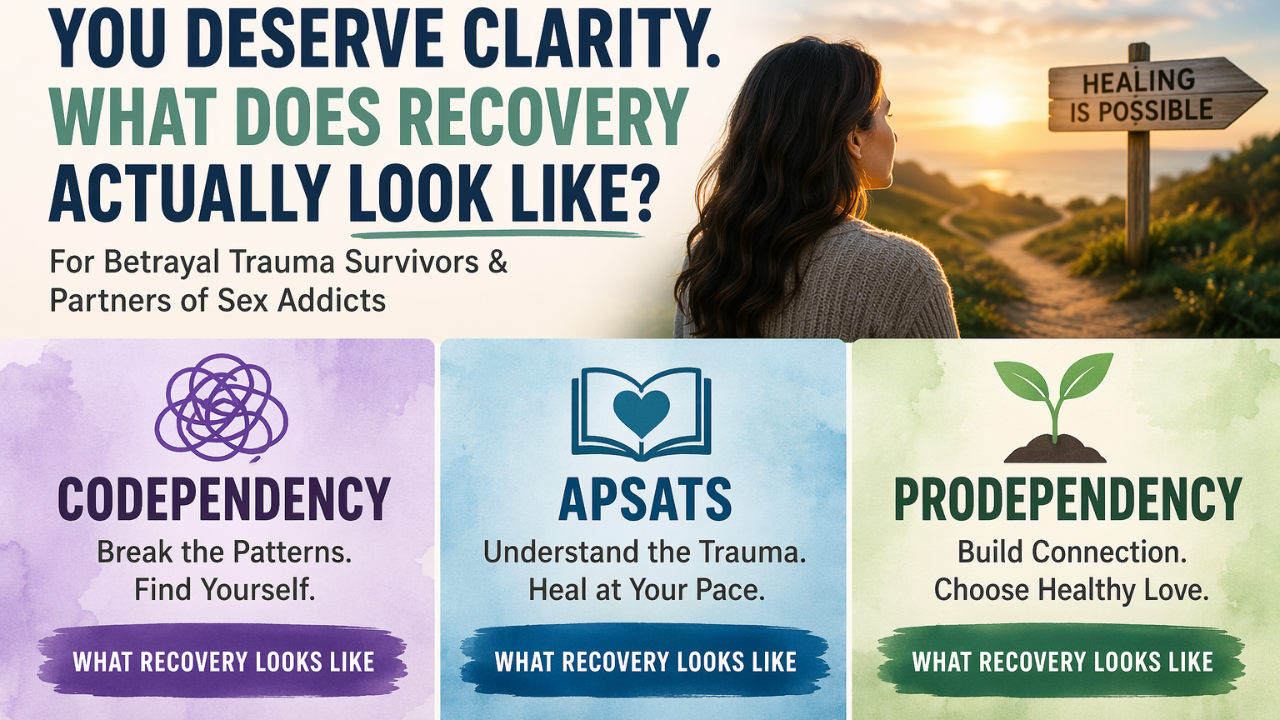
The field has developed three distinct frameworks for understanding what you are experiencing and what healing looks like. Each sees something real. Each has limits. Understanding all three — what each offers, what each misses, and what they share — may help you find the path that fits your situation most accurately and most honestly.
This article is written for you. Not primarily for clinicians, though clinicians may find it useful. For you — the person sitting in the wreckage of a betrayal, trying to understand what happened, what you are feeling, and what comes next.
You did not cause this. Your responses make sense. And your healing does not wait on him.
Before The Frameworks: What All Three Agree On
All three frameworks agree that you did not cause this. Your partner's compulsive sexual behavior is not a reflection of your inadequacy or your failure. Whatever was happening in your relationship before the discovery, his behavior was his — rooted in his own wounds, his own history — and it is his to address.
All three agree that your responses — however extreme, however frightening to yourself or others — make sense in the context of what you have been through. The checking, the monitoring, the inability to trust your own perceptions, the oscillating between fury and desperate need — these are understandable human responses to an extraordinary stressor. They are not signs that you are crazy or controlling.
All three agree that you deserve your own healing — independent of what your partner does or doesn’t do, independent of whether the marriage survives, independent of whether he achieves recovery. Your healing is yours. It does not wait on him.
And all three agree that finding a therapist who specializes in this specific terrain is essential. This is not a situation that benefits from generic couples counseling or general talk therapy. The specific wound you are carrying requires specific expertise.
With that shared ground established — here is what each framework offers, and where each one falls short.
Framework One: The Codependency Model
What It Is
The codependency model dominated sexual addiction treatment for decades. It emerged from the broader addiction treatment world — Al-Anon, family systems work organized around alcoholism — and was applied to partners of sex addicts by Patrick Carnes and others beginning in the 1980s.
In this framework, the partner of a sex addict is a co-addict — someone whose own psychological patterns have made her a participant in the addictive system. Her controlling behaviors, her hypervigilance, her obsessive focus on her partner's recovery — these are symptoms of her own illness, her own codependency, requiring her own treatment.
The model referred partners to S-Anon, a twelve-step program modeled on Al-Anon, where they were encouraged to examine their own patterns and work toward detachment from the addict's behavior. Recovery meant becoming less reactive, less controlling, less focused on what he was doing.
What It Got Right
The codependency model got one thing right that the frameworks that followed have sometimes lost: the recognition that the partner has her own work to do — work that is hers, independent of him, that does not wait on his recovery.
Twelve-step programs for partners also offer something real: community. The experience of sitting with other women who understand — who have lived the midnight checking, the detective work, the shattering discovery — is not nothing. It is often the first time a betrayed partner feels truly seen and not alone. That communal healing has value and should not be dismissed.
What It Got Wrong
The codependency model caused real harm to betrayed partners in several ways.
It implied that the partner's patterns had contributed to the addiction — that something in her relational psychology had made her a participant in what happened to her. That implication is factually wrong and damaging.
It pathologized normal human responses to extraordinary stressors. A woman who cannot stop checking her husband's phone after discovering years of secret sexual behavior is not demonstrating codependency. She is demonstrating a nervous system that has been through something shattering and is trying, by any means available, to prevent it from happening again.
It asked partners to detach and focus on themselves at the exact moment they needed, above all, to be told that their responses made sense.
The Bottom Line: The codependency model is not the right framework for understanding what you are experiencing. Your responses are not symptoms of your own disease. You are not a co-addict. What it offered that still retains value is the recognition that your healing matters — and that community matters too.
Framework Two: The Betrayal Trauma Model — APSATS
What It Is
The betrayal trauma model emerged as a direct correction to the harm caused by the codependency framework. Barbara Steffens conducted the foundational research arguing that betrayed partners were not co-addicts but trauma survivors experiencing genuine traumatic stress in response to significant relational betrayal.
Steffens and other clinicians founded APSATS in 2011, building a professional training and certification body around this framework. The heart of the APSATS approach is the Multidimensional Partner Trauma Model, which understands partner responses as trauma-driven safety-seeking behaviors affecting multiple dimensions of a person’s life simultaneously: emotional, psychological, physiological, relational, sexual, and spiritual.
In this model, the partner of a sex addict seeks what she cannot find: safety in an unsafe situation. Her hypervigilance, her monitoring, her rage, her obsessive need to know — these are not symptoms of pathology. They are predictable responses of a nervous system to genuine threat.
What It Gets Right
The APSATS framework gets the most important thing right: what happened to you is real, it is traumatic, and your responses to it are normal.
The research confirms what you already know from the inside — that the discovery of a partner’s secret sexual behavior produces symptoms consistent with traumatic stress. The obsessive thoughts, the hypervigilance, the intrusive memories, the inability to trust your own perceptions — these are not signs of weakness. They are signs of a nervous system that has been through something shattering and is responding accordingly.
The APSATS framework also insists that you deserve your own treatment track — one centered on your trauma and your healing, not on your relationship to his recovery. Your healing is not contingent on whether he gets better. It belongs to you, on your timeline.
APSATS-trained clinicians are equipped to understand the specific dynamics of sexual betrayal — the gaslighting, the deception, the shattering of reality that comes with discovering your partner has been living a secret life.
The recognition that partner trauma affects multiple dimensions of life simultaneously is accurate and practically important. Your trauma is not only emotional. It is physiological. It is sexual. It is spiritual. Healing all of these dimensions requires a broad approach, and the APSATS framework provides one.
What It Leaves Unaddressed
The APSATS framework, despite its contributions, rests on a research base with limitations worth understanding. The foundational study examined a small and narrow sample of women already embedded in the sexual addiction treatment world.
More significantly, the study’s own regression analysis found that the strongest predictor of trauma symptom severity was not how the disclosure happened, not how the husband responded, and not the extent of the acting out. The strongest predictor was the partner’s number of prior traumatic event exposures.
What this means in practice: if you had significant prior wounds — attachment injuries, trauma history, relational patterns organized around experiences that predate this marriage — those wounds may be contributing significantly to the severity and specific form of what you are experiencing right now.
That does not mean the betrayal is not real. It does not mean your responses are not valid. It means the most complete path to healing may require attending to what was already there — not instead of the betrayal trauma work, but alongside it.
The Bottom Line: The APSATS betrayal trauma framework is the most research-grounded framework currently available for understanding and treating what you are experiencing. It offers real validation, a multidimensional treatment model, and specialized care centered on your healing.
Framework Three: The Prodependency Model
What It Is
The prodependency model was introduced by Robert Weiss in 2018. Weiss argued that the codependency model’s central error was pathologizing love — and that a more accurate and compassionate approach would recognize partner responses as expressions of love and attachment operating under extraordinary pressure.
Prodependency holds that when a partner monitors her husband’s phone, checks his location, or struggles to emotionally detach from the crisis of his addiction, she is not sick and she is not only traumatized. She is attached. She loves someone who is hurting her and is responding to that love in the only ways available to her in this moment.
What It Gets Right
The prodependency model offers something that the APSATS framework can sometimes leave underemphasized: your agency.
You are not only someone who has been harmed. You are a person who loves — who chose this relationship, who has invested in it, who is capable of enormous resilience.
Prodependency’s insistence that your responses arise from love rather than pathology is humanizing in a way that matters. It removes the implicit suggestion that you are broken in a way that requires repair before you can function.
The model is also practically useful for partners who do not resonate with the trauma frame and experience their responses more as expressions of love and commitment than as symptoms of injury.
What It Leaves Unaddressed
The prodependency model rests on a thinner research base than the APSATS framework. It is built primarily on clinical observation and attachment theory rather than on original research examining betrayed partners directly.
It also has a real limitation in certain severe presentations. When partner responses include coercive control, sustained psychological harm, or physical violence, the framework’s insistence on meeting those responses as love may be insufficient.
Its urgency to avoid pathologizing can, in certain cases, leave it without adequate language to name what it is seeing.
The Bottom Line: The prodependency model offers a real contribution — particularly its insistence on your agency, your love, and your capacity for healing. What it lacks is a stronger empirical base and clearer language for cases where the expression of love has become harmful.
What The Three Frameworks Together Are Telling You
Read together, these three frameworks are pointing toward a picture of partner healing that is more complete than any single framework provides.
- Your responses are not pathological
- Your experience is genuinely traumatic
- Your reactions also arise from love and attachment
- Your prior history may shape the severity and form of what you are experiencing
No single model tells the whole truth. Together, they come closer.
You are not only someone who has been harmed. You are also someone who loves, someone with history, and someone capable of healing.
Why Your Healing Matters Beyond You
There is something that all three frameworks share at their roots, even if they have not all said it explicitly: addiction is, at its core, an attachment wound.
Early relational deprivation and attachment disruption are central to the development of compulsive sexual behavior. The brain wiring that makes intimacy feel dangerous — that makes a secret life feel safer than a real one — is attachment wiring. It developed in relationship. And it is in relationship that it has its best chance of changing.
This matters for your healing in a way that none of the three frameworks has said clearly enough.
When you heal — when you develop your own secure base, when you process your own attachment wounds, when you become more regulated, more boundaried, and more genuinely yourself in relationship — the relational field changes. Not because you are responsible for his recovery. You are not. Not because your healing fixes him. It does not. But because two people in a relationship are always affecting each other’s nervous systems.
There is also the matter of the children. If there are children in this home — or if children are coming — your healing is one of the most important things you can do for them. A mother who has processed her own wounds and developed her own regulation creates a fundamentally different attachment environment for her children than a mother whose body is always on alert.
None of this means you heal for him. You do not. It means that when you heal — genuinely, deeply, for yourself — the effects ripple outward in ways that serve everyone you love.
Need support for betrayal trauma healing?
You do not have to sort through this alone. Specialized support can help you stabilize, understand what you’re experiencing, and begin healing with clarity and care.
Explore Support OptionsWhat Healing Actually Looks Like
Regardless of which framework resonates most with your experience, the practical elements of healing share more across all three than the theoretical differences between them suggest.
- Your own therapist. Not a couples therapist. Not his therapist. Your own — someone who works specifically with betrayal trauma and partner healing.
- Your own recovery community. Whether that is S-Anon, COSA, a betrayal trauma support group, or another form of peer community.
- Your own timeline. Your healing does not wait on his recovery. It belongs to you.
- Whole-person healing. Emotional, physiological, sexual, spiritual, relational.
- Possibly addressing what came before. If prior trauma exists, the most complete healing may require tending to those wounds too.
You deserve a therapist who can hold all of you. Not only your trauma. Not only your love. Not only your prior history. All of you.
Helpful support resources
A Final Word
The frameworks discussed here were each built by people who wanted to help — who saw partners being failed by inadequate clinical responses and worked to build something better. Each got important things right. Each has limits. None of them is the final word on what you are experiencing or what your healing requires.
You are more than any framework can fully contain. You have been through something devastating. You love with real depth. You carry a history that is yours alone. And you are capable of a healing that is more complete than any single model has yet fully described.
What happened to you was real. Your responses make sense. Your healing is possible. And you deserve every bit of it.
Ready for a clearer path forward?
Get support, education, and guidance designed specifically for partners healing after sexual betrayal.
Learn MoreReferences
American Psychiatric Association. (2000). Diagnostic and statistical manual of mental disorders (4th ed., text rev.). Washington, DC: Author.
Bowlby, J. (1988). A secure base: Parent-child attachment and healthy human development. New York: Basic Books.
Carnes, P. (1991). Don't call it love. New York: Bantam.
Foa, E. (1995). Posttraumatic stress diagnostic scale manual. Minneapolis, MN: NCS Pearson.
Green, B., Goodman, L., Krupnick, J., Corcoran, C., Petty, R., Stockton, P., & Stern, N. (2000). Outcomes of single versus multiple trauma exposure in a screening sample. Journal of Traumatic Stress, 13(2), 271–286.
Humphreys, K., Moos, R. H., & Cohen, C. (1997). Social and community resources and long-term recovery from treated and untreated alcoholism. Journal of Studies on Alcohol, 58(3), 231–238.
Johnson, S. (2002). Emotionally focused couple therapy with trauma survivors. New York: Guilford.
Kessler, R. C., Sonnega, A., Bromet, E., Hughes, M., & Nelson, C. B. (1995). Posttraumatic stress disorder in the National Comorbidity Survey. Archives of General Psychiatry, 52(12), 1048–1060.
Schore, A. N. (2003). Affect dysregulation and disorders of the self. New York: Norton.
Steffens, B. A. (2005). The effects of disclosure on wives of sexual addicts. Unpublished doctoral dissertation, Regent University, Virginia Beach, VA.
Steffens, B. A., & Means, M. (2009). Your sexually addicted spouse: How partners can cope and heal. Far Hills, NJ: New Horizon Press.
Steffens, B. A., & Rennie, R. L. (2006). The traumatic nature of disclosure for wives of sexual addicts. Sexual Addiction & Compulsivity, 13, 247–267.
Weiss, R. (2018). Prodependence: Moving beyond codependency. Deerfield Beach, FL: Health Communications.
Wildmon-White, M., & Young, J. S. (2002). Family-of-origin characteristics among women married to sexually addicted men. Sexual Addiction & Compulsivity, 9, 263–273.
Don't miss a beat!
New moves, motivation, and classes delivered to your inbox.
We hate SPAM. We will never sell your information, for any reason.
Author