The Fifth Seat Is Empty: Why the Kitchen Table Works
Aug 13, 2026Why the Table Has the Shape It Has
If you're coming to this cold, here's the practice in a paragraph.
The Kitchen Table™ is five voices, spoken in the same order, every morning.
- Child first — the most vulnerable, the raw feeling, no editing.
- Critical Parent second — the protector, the one that uses shame as a shield, and it gets to talk.
- Teen third — rebellion, agency, the part that needs to choose even when it chooses badly.
- Loving Parent fourth — compassion, finally, after everyone else has had their say.
- Witness last. Same order, same time, same place. Ten or fifteen minutes. The content is different every day; the sequence never changes. That's the whole thing.
I didn't design it. I wrote down five voices in the order they showed up one morning and then spent years finding out why that order worked.
What I want to do here is something I've mostly kept to myself, because it's the kind of thing that gets you dismissed fast in a clinical room and worshipped fast in the wrong kind of room, and I'm not interested in either. But it's real and it's structural and I think it's useful, so here it is.
Five parts with a center is not a shape I invented. It's a shape that keeps showing up, in places that never spoke to each other, whenever people try to describe how a fractured thing becomes whole. I want to walk through a few of those, use the one most people can read on sight, and be honest about where the whole exercise could be fooling us.
The center is the Witness
Start here, because everything else follows from it and because it's the piece I got wrong for the longest time.
At the table, the Witness goes last. For years I described it as sealing the sequence — awareness closing the loop, integration, the thing that keeps the parts from immediately fragmenting again. That's what I wrote in the last chapter and I'd change it now.
The Witness doesn't seal anything. The other four do. How the Child settles with what was said, how the Critical Parent softens or doesn't, whether the Teen stops pushing — that's the seal. The closing happens in the four of them, afterward, offstage.
So what's the Witness?
It's a process, not a person. Nobody occupies it. You approach it and fall short in some particular traceable way, and the falling short isn't failure — it's the shape the process takes when it happens inside somebody with a history.
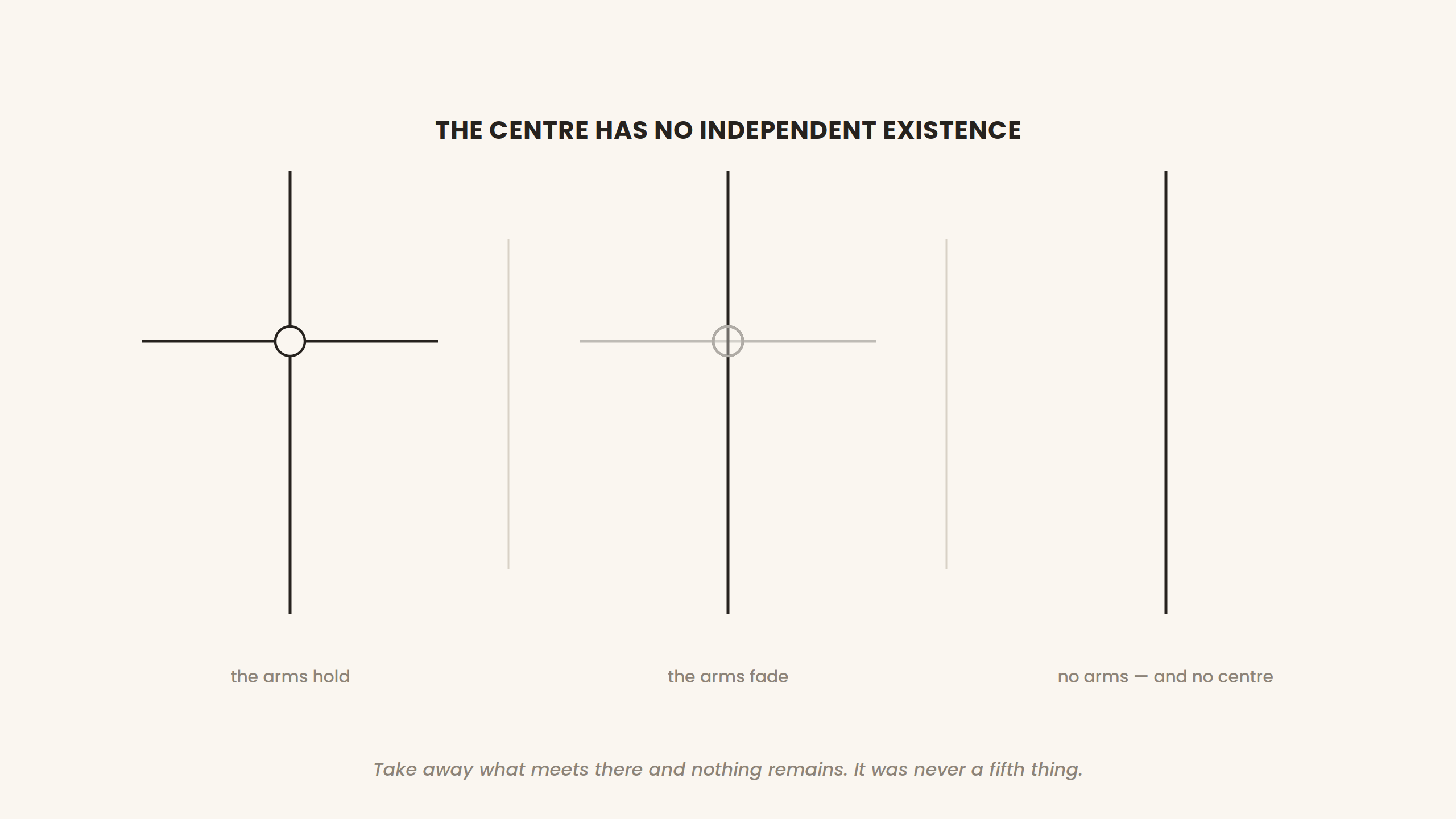
Now draw a cross. Two lines. Four ends and a place where they meet.
The center of a cross isn't a fifth point. It's where the four cross. Take away the arms and there's no center left — nothing is there. It has no independent existence. It is constituted entirely by the meeting.
That's the Witness. Not a seat. The fact of the four having met.
I'd been trying to fill a chair that was never a chair.
Crux, crucible
The word for that meeting point is crux. It's the Latin for cross, and it's where we get crucial — Bacon's phrase was instantia crucis, the crossroads case, the fork in the road where the thing finally gets decided. When we say something is the crux of the matter, we're saying it's the place where the lines meet and the answer comes out.
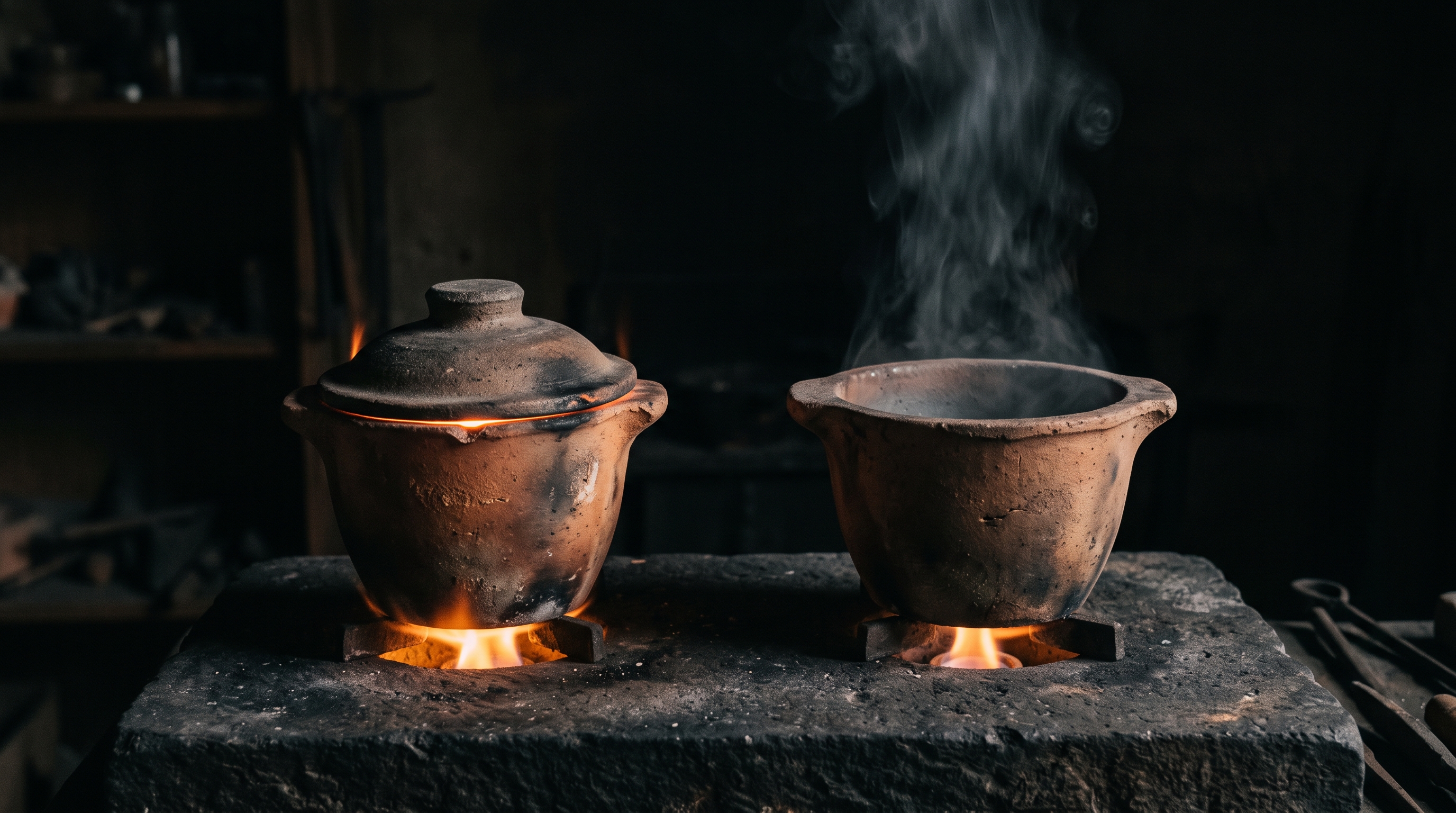
Crucible is the one I want, and I'll be honest that the link is contested. Some trace crucibulum to crux; others to an old Germanic word for pot. It might be folk etymology. But the folk got there for a reason, and the reason is that the two words describe the same event.
A crucible is a vessel you put things in and apply heat to. And the thing every alchemical text hammers on — the vas hermeticum, the sealed vessel — is that heat alone does nothing. Open the pot and the volatile part escapes. You get heat and loss and no transformation.
Which taught me something about my own practice that I hadn't seen.
I've been describing the order of the Kitchen Table as rhythm. Predictability. Safety through sequence. All true. But the order is also containment. It's what keeps the Teen and the Critical Parent in the pot instead of the fight leaking out the sides and dissipating into your morning, your commute, your marriage.
Tension without a vessel is just conflict. Tension inside a sealed vessel is a crucible.
That's not a metaphor about the practice. It's a description of the mechanism. The reason the parts speak in order and don't interrupt each other isn't discipline or politeness. It's that an unsealed vessel doesn't work.
So the Witness gets one more thing it isn't. Not a seat. Not an occupant. Not even an observer, really.
It's the containment.
Where everything sits
Before I go further I should just draw it, because I've noticed that when I explain this out loud people nod and then ask a question that tells me they were picturing something else entirely.
Take a cross. One line running up and down, one running side to side.
At the foot: the Child. Lowest point, in the ground, under everything.
On the two arms: the Critical Parent and the Teen. One on each side, pulling against each other.
On the upright, between the foot and the crossing: the Loving Parent. Standing between the child and whatever comes down the line.
At the crossing: the Witness. Which is not a point on the figure so much as the place the two lines pass through each other.
At the top: nothing.
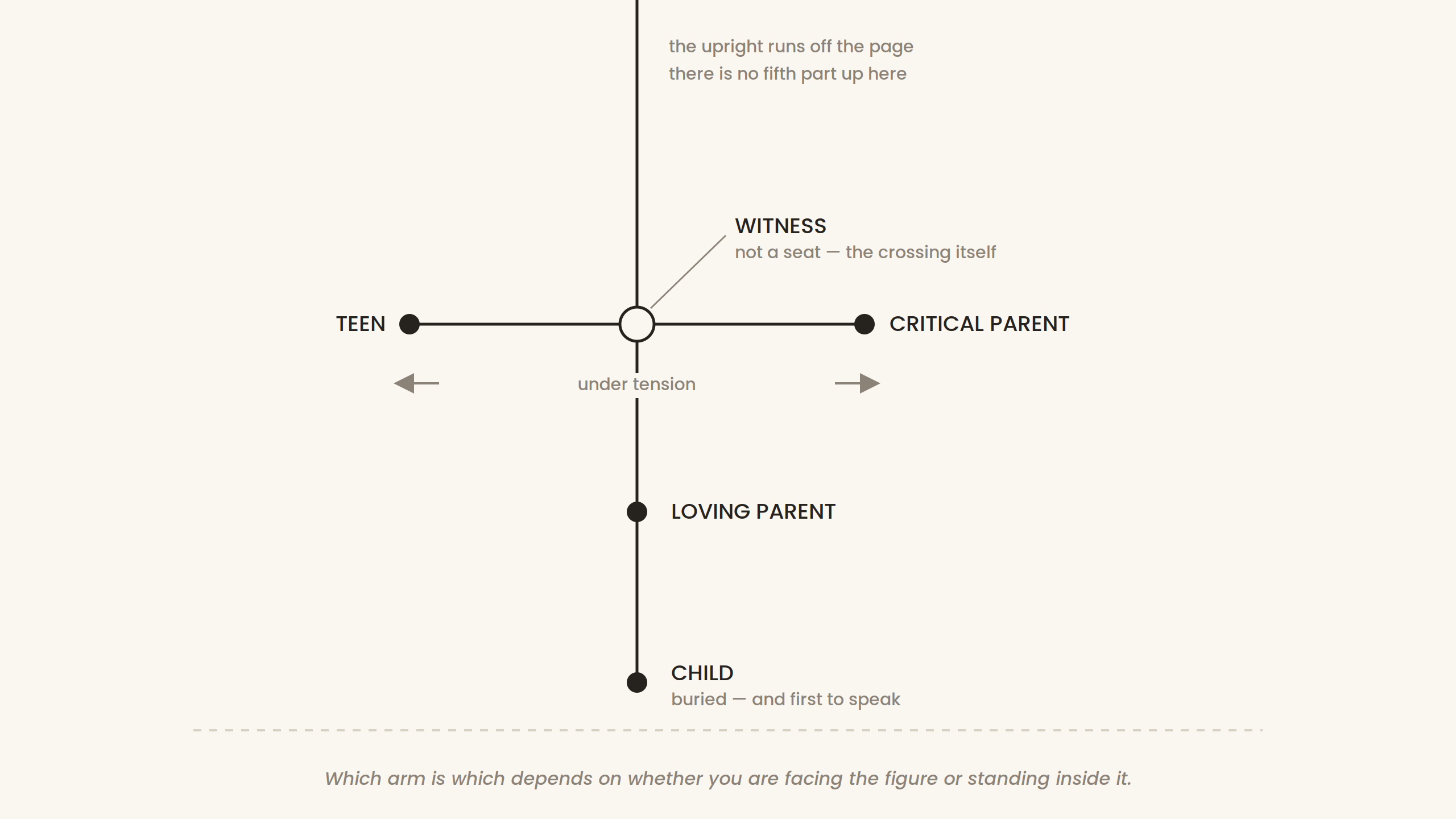
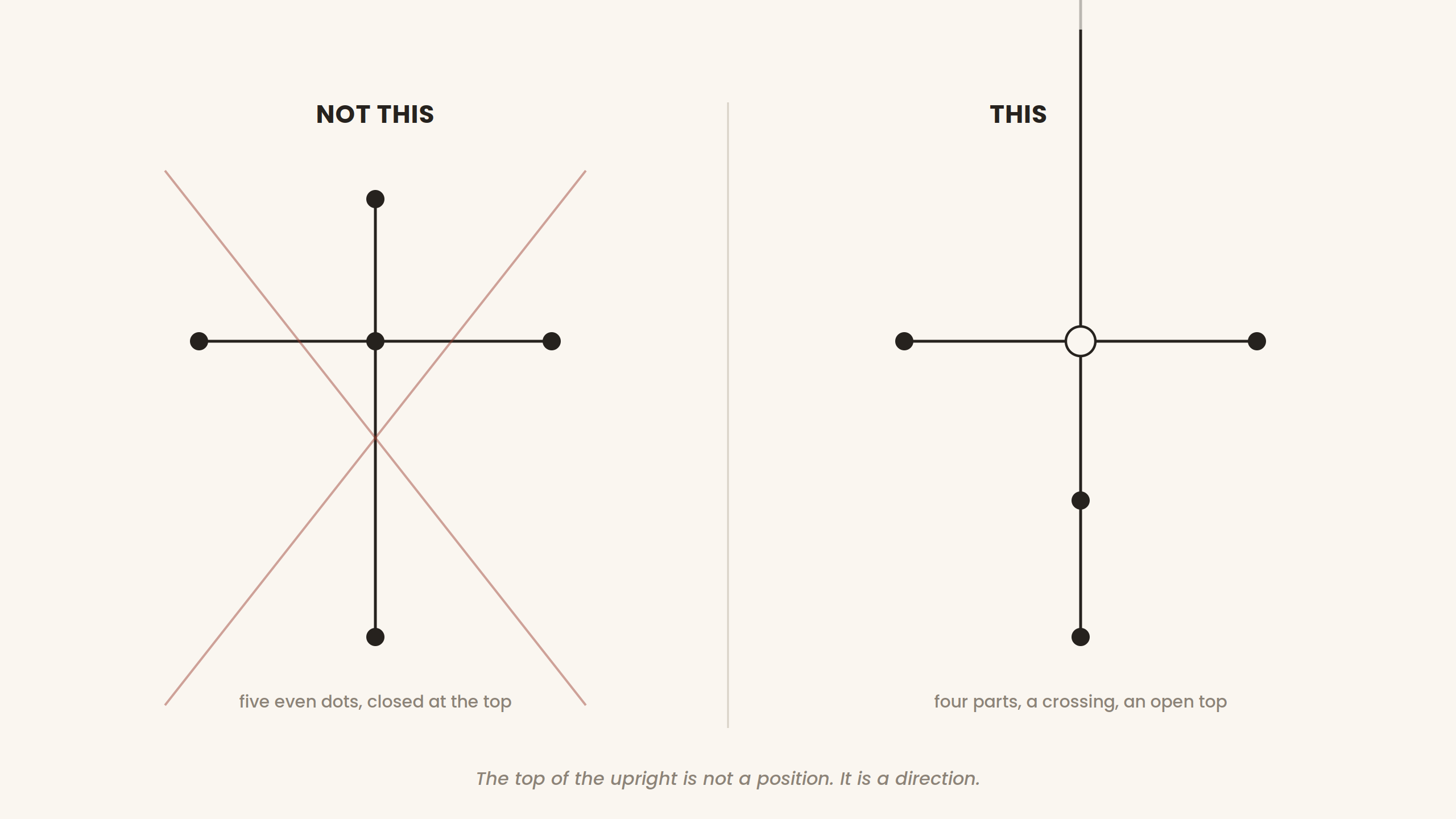
That last one is not an oversight and I'll come back to it. There's no fifth part up there. The top of the upright isn't a seat — it's a direction. It's where the line comes from.
So: four parts on the figure, one crossing, and an open end above. If you're picturing five dots evenly spaced, redraw it. Four of them are on the figure and one of them is a hole.
The vertical: something under, something open
The Child goes first. Lowest and first, and everything else stands on it.
I've come to see the Child at the foot — in the ground, under the floor of the thing, coming up. Not sent away to a far country. Buried. Right there the whole time, holding the structure up. You don't travel to reach it. You dig, or the ground opens.
Now the top, which I said was empty.
Something looks down. In the practice it shows up as the capacity to see yourself as though you were someone else — your own logical mind, turned around, momentarily treating you as third-person. Everyone has this. Almost nobody can hold it for long, because the moment you examine yourself you're in the room with a stake in the answer, and the stake bends the instrument.
Here's what I got wrong for a while, and it's an easy mistake to make.
I tried to put that looking-down at the top of the cross, as a fifth position — as if somebody were up there. But it isn't a position. It's a direction. The line, not a point on the line. Whatever is at the origin of it sits outside the figure, and the drawing doesn't tell you what that is. Some people have a name for it. Some don't. The diagram is silent on the question and I'd leave it silent.
What you get on the page is an open end. The upright doesn't finish in a dot. It runs off the top.
So the vertical is: buried child at the bottom, an open line running up and out of the frame, and everything else is the body it passes through.
The Loving Parent lives on that line, between the child and the crossing. Which is exactly what a loving parent is, positionally — the one standing between the child and whatever is coming down.
The horizontal is under tension, and that's the point
Here's where I'd push against most contemplative framings.
The two arms of the table are the Critical Parent and the Teen. Restriction and agency. Boundary pressing in, rebellion pressing out. Not enemies — poles under load. A beam is only a beam because something is pulling on both ends.
The Kabbalists put severity on one pillar and lovingkindness on the other and spent a lot of ink on why you need both and can't take either alone. Severity is Gevurah — boundary, restriction, the no. Lovingkindness is Chesed — expansion, reaching, the yes. That's the Critical Parent and the Teen, near enough that it stopped me when I first saw it.
Which arm goes on which side is a question I'll answer in a minute, and the answer is stranger than you'd expect.
The Chinese five-phase system has a generating cycle and a controlling cycle running simultaneously — one phase feeds the next, and a different one restrains it, and health is not the absence of restraint but the balance of feeding and checking. Neither tradition treats the tension as a problem to be eliminated. Both treat it as the mechanism.
Which changes what a bad morning at the table means.
The day the Teen and the Critical Parent are at each other's throats is not the day the practice failed. That's the day the beam is loaded. Whatever comes through, comes through there — at the crossing, at the point of maximum tension, not in some quiet clearing where everyone agrees.
Most people expect the center to be calm. I think the center is where the fight is, and something passes through it precisely because the fight is happening.
The alchemists had two words for this that I wish I'd had twenty years ago.
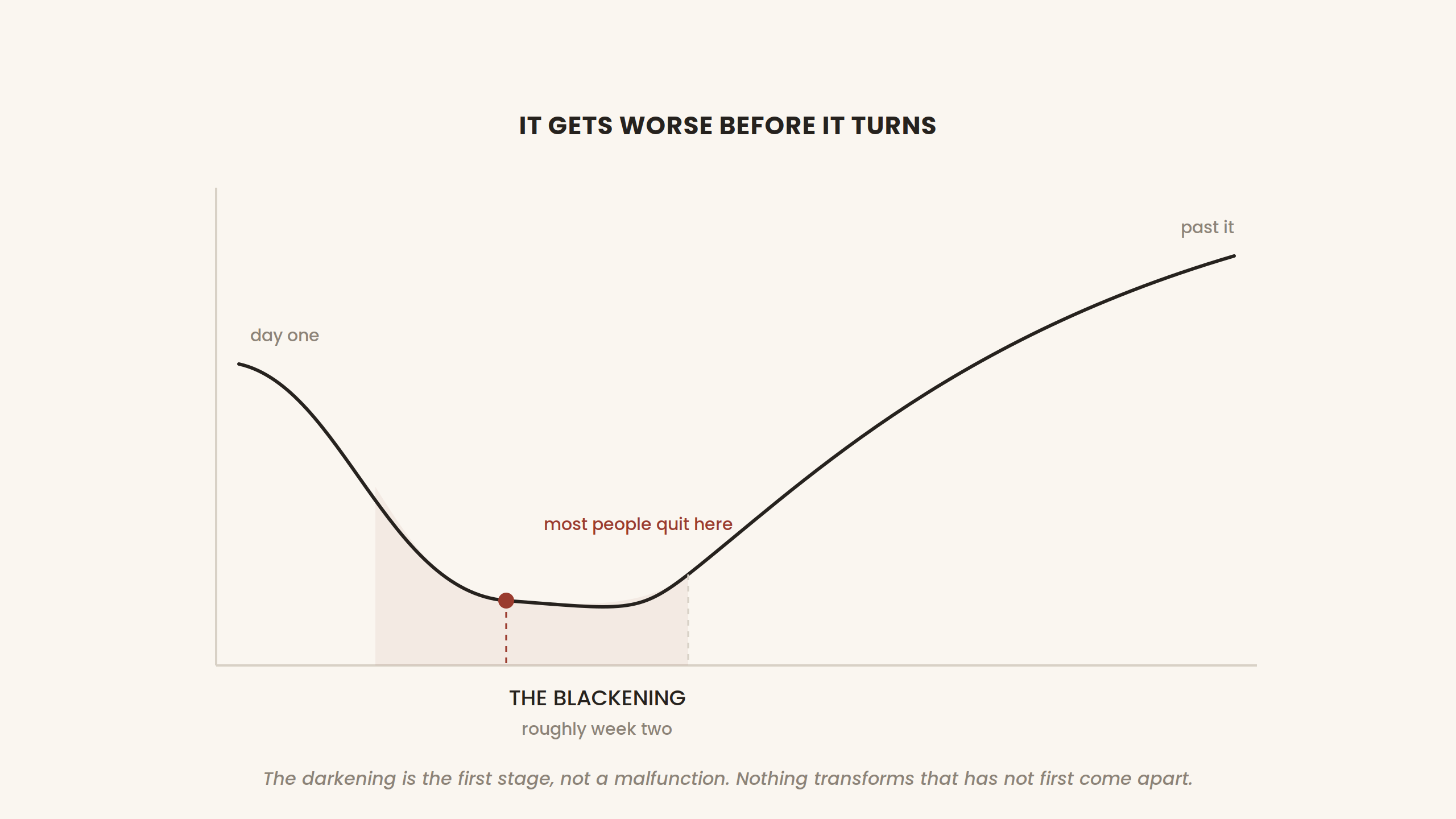
Nigredo. The blackening. Putrefaction, rot, the thing coming apart. And it isn't a setback or an early failure — it's the required first stage. Nothing transforms that hasn't first fallen apart in the pot. Which means the morning your parts are at their ugliest, when the Child is whimpering and the Critical Parent is savage and the Loving Parent can't get a word out, you're not failing the practice. You're in the black. Stop looking for gold. That's where you're supposed to be.
I've watched people quit at exactly that point. They'd been doing it for nine or ten days, it got worse instead of better, and they concluded it wasn't working. It was working. That's what the working looks like from inside.
Coniunctio. The conjunction — the union of opposites into a third thing that is neither one of them. Not the Teen winning. Not the Critical Parent winning. Not a negotiated compromise where each gives up half. A third thing that didn't exist in either, and that comes through precisely because both of them held their ground.
Jung spent the last decades of his life on this material and read the whole alchemical corpus as psychology — the pot was never really about lead and gold. It was about what happens to a person when two irreconcilable things are held in one container long enough and hot enough.
That's the crossing. That's what you're doing at your kitchen table with a cup of coffee.
The cross, because most people can read it
I use this one because it's legible to almost everyone in my rooms, not because I think it's the true one and the others are copies.
Four ends and a crossing. Something buried at the foot that comes back up out of the ground. An upright that runs off the top of the frame toward an origin the picture doesn't name. Two arms in tension — and in the story, two men crucified beside him, one on each side, one of whom sees the situation accurately and says so. The center where the upright passes through the crossbeam, occupied by nobody, constituted by the meeting.
And in the Catholic gesture — forehead, then down, then shoulder to shoulder — you're not drawing the figure. You're marking your own body as the place it passes through. Above, then the descent, then across. It's not a diagram. It's an enactment.
One more thing worth knowing, and it answers the question I left hanging about which arm goes where.
Hold your hands out and face someone. Your right hand meets their left. Two people facing each other can never agree on which side is which — one of you says right, the other says left, and you're both correct. Contact happens crosswise. It has to.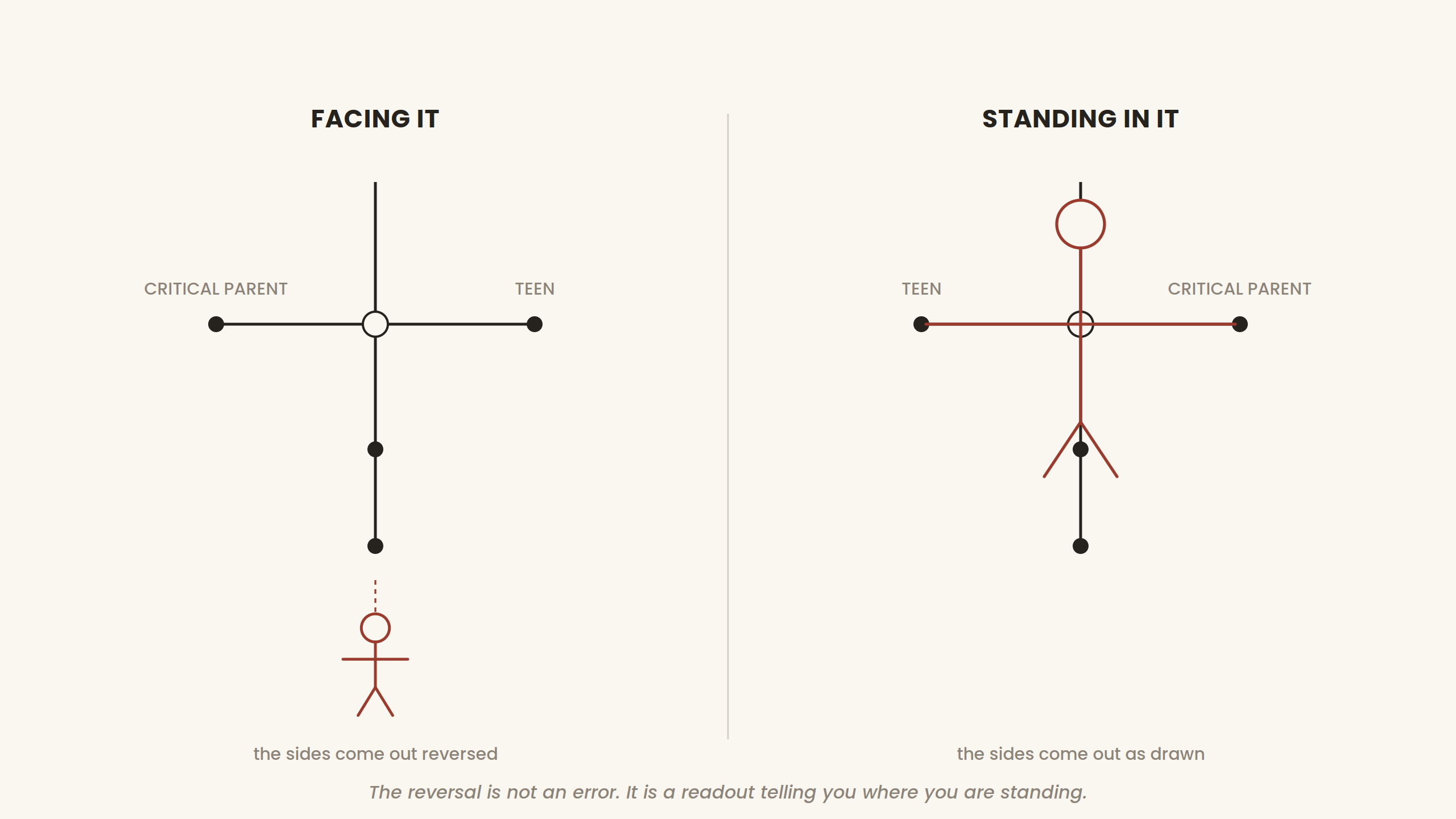
Now notice that a diagram has the same problem. The Kabbalistic tree is conventionally drawn from the inside looking out — the sides are labeled as its right and left, not yours. Stand in front of it and everything is reversed. Step into it, face the same way it faces, and the labels come out right.
So here's the practical version, and it's the only part of this you need to remember:
If the sides come out backwards, you're facing the thing. If they come out right, you've stepped into it. Same figure, two postures. The reversal isn't an error to correct — it's a readout telling you where you're standing.
Which is why I won't tell you which arm the Teen goes on. Draw it facing you and it lands one way. Draw it as if you're standing inside it, looking out through it, and it lands the other. Both drawings are correct and they're pictures of two different relationships to the practice. Worth noticing which one you drew without thinking.
The same load, carried in other shapes
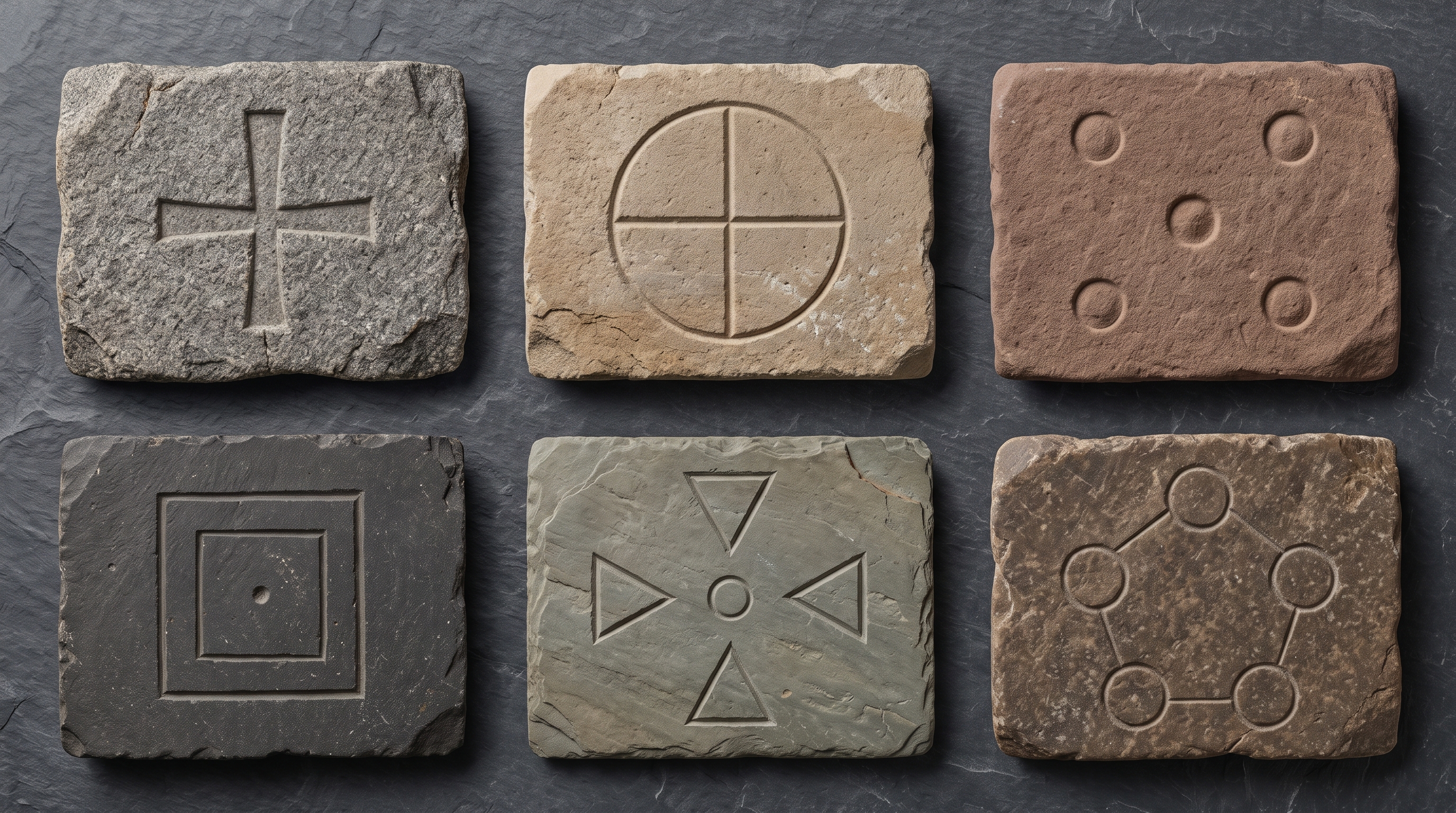
The four elements and the fifth. Earth, water, air, fire — and then quintessence, aether, the fifth thing that isn't an element. It has no properties of its own. It's what the four are suspended in. Whoever came up with that had the same problem I had with the Witness and solved it the same way: the fifth is not another one of these.
The medicine wheel. Four directions and a center, and in most teachings the center isn't a place on the map. It's where you're standing. You can't point to it from outside because it moves with the one looking.
The mandala. Four gates at the cardinal points, a center, and the whole thing is built to be entered rather than viewed. Same instruction as the tree: this was not made to be looked at.
The world tree. Roots going down into a place with something living under them, crown going up into a place with something watching from it, and traffic running the length between. The vertical axis, with a below that isn't hell and an above that isn't heaven — just two ends of one line.
Wu Xing. Five phases, generating and controlling at once. No phase is the good one. Illness is imbalance, not the presence of a bad element.
The five wounds. Two hands, two feet, and the wound in the side — four at the extremities and one at the middle. Medieval devotion laid them out as a quincunx (the five-dot pattern on a die) and prayed them one at a time in fixed order, which is not far off what I ask people to do at a table with a cup of coffee.
None of these are each other. I'm not claiming a hidden universal religion. I'm claiming something narrower: when people try to describe how something fractured becomes whole, this shape keeps coming out — four in tension, a center that isn't a fifth thing, and a vertical that runs from something buried to something looking down.
Where I could be fooling myself
Now the part I'd want someone to say to me.
Almost anything with five parts will accept this reading. Four-plus-center is one of the most permissive patterns there is. Medicine wheels, elements, mandalas, directions, Vastu, the seasons plus the year — they all fit, and none of them are the same as each other. Give me any five-part system and an hour and I'll map it to a cross. That's not evidence of anything except that I'm good at mapping.
So the test isn't whether it fits. It'll fit.
The test is whether the mapping tells you something about the practice you didn't already know.
For me, exactly one thing passed that test: the center has no occupant. That corrected a real error I'd been making for years — trying to fill a seat, treating the Witness as a role someone plays, wondering why it never quite worked. The geometry told me why. Everything else in this chapter is elegant and I hold it loosely.
Two others might have passed and I'm not sure yet. The sealed vessel — that the order is containment and not just rhythm — changed how I talk to people about interrupting the sequence, so it earned something. And nigredo, which gave me language for the week-two darkening that I'd previously had to describe as "this is normal, hang in there," which is not language, it's reassurance.
Ask me about both in a year.
I'd add one caution about the alchemy specifically. That material is designed to be endlessly interpretable — it was written in deliberate code by people who had every reason to be obscure, and a body of text that opaque will accept almost any reading you bring to it. Jung's psychological reading is one, and it's brilliant, and it is not the only one available. I use it because it named two things I'd already observed. I'd be suspicious of myself if I started using it to predict things I hadn't.
The rest is scaffolding. Useful for orientation. Not load-bearing.
What it changes on a Tuesday
Three things, and they're small on purpose.
Stop trying to be the Witness. You can't occupy it. Attempt it daily, accept that you'll fall short in a specific traceable way, and treat the shape of your shortfall as the actual data. Where you consistently fail to see yourself clearly is more informative than any morning you think you nailed it.
Let the four seal it. Don't look for a feeling of completion at the end of the sequence. Completion is what happens afterward, in how the parts settle with what got said. Sometimes that takes hours. Sometimes it takes until the next morning.
Don't flee the loud sessions. When the Teen and the Critical Parent are locked up, you're at the crossing. That's not a failed practice. That's the mechanism running under load.
Keep the lid on. The order isn't etiquette. It's the seal. Every time you let a part jump the line, or carry the fight out of the sequence and into your day, you've opened the vessel and the heat goes to waste. Fifteen minutes contained does more than three hours leaking.
If it gets worse before it gets better, that's the sequence, not a malfunction. Somewhere around week two the thing usually darkens. People quit right there. Don't. You're in the black and the black comes first.
And one more, which I'd put underneath all of it:
The Child is under the floor. Not gone, not far, not lost. Buried, and holding the whole thing up. Every morning you sit down and let it speak first, you're not retrieving something from a distance. You're letting the ground open a little.
How this was written: the thinking here happened in conversation with Claude over a couple of hours. I'm not going to pretend otherwise, and I'm not going to pretend it wrote it either. What it did was hold the thing still while I turned it over — offer a frame, take the correction, offer a better one. The examination is mine. Several of the sentences are its. Where I got somewhere I couldn't have gotten alone, it was because something was willing to be wrong out loud fast enough for me to see what was wrong with it.
Don't miss a beat!
New moves, motivation, and classes delivered to your inbox.
We hate SPAM. We will never sell your information, for any reason.
Author